
Nizar Farsakh is a Palestinian-American political analyst with extensive experience in the Israel-Palestine conflict as well as the US’s Middle East policy. Nizar advised the last two Palestinian ambassadors to Washington D.C. (2011-2017) and had worked as a political advisor to senior Palestinian leaders (including the President, Prime Minister, and several ministries) in his capacity as member of the Palestinian negotiating team (2003 to 2008). Nizar is currently Lecturer of International Affairs at George Washington University where he teaches a graduate negotiation skills course.
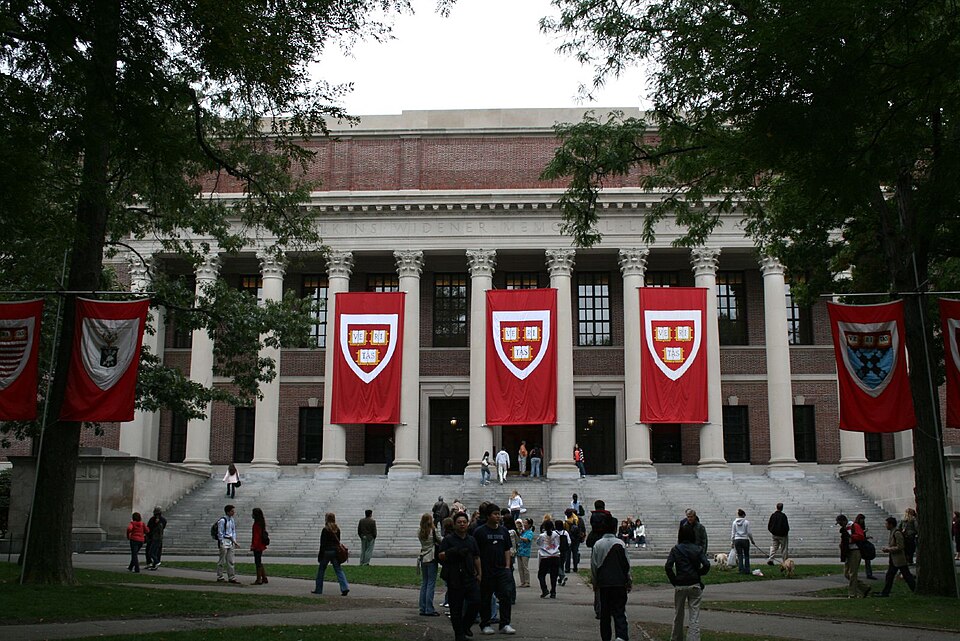
There has been a lot of fanfare and commotion around the letter Harvard President, Alan Garber, wrote to the Harvard community titled, “Our of Resolve” and subsequent “The Promise of American Higher Education.” It was sent to the Harvard community the day after the Trump administration announced that $9 billion in federal contracts and grants with the university would be reviewed for what it said was the university’s failure to combat antisemitism on campus.
I read it several times just to find what people found so inspirational and defiant. One would think it surpassed Churchill’s “we’ll fight them at the beaches,” one of the most powerful political oratories of all time. While I can see how witnessing an academic institution refusing to obey government diktats would impress people, I am genuinely surprised that no one noticed how exceptionally weak and embarrassingly underwhelming it was given Harvard’s stature and standing.
First, the administration’s demand for ending DEI programs and replacing them with merit-based ones would carry weight if indeed it stopped at that. However, they are actually calling for ideology, not DEI, to be the deciding factor rather than merit when they also insist that academic and administrative decisions be made with the intention of enforcing diversity of opinions. Garber should have made this clear rather than giving merit to the administration’s weak logic.
The system’s lack of merit-basedness is not the administration’s grievance. It has to do with the fact that its values diverge from its own. Granted, a democratic system is of course a competition between ideologies. The administration is elected to implement policies concurrent with the ideology it embodies and for which the majority of the electorate gave it a mandate. From that, decisions flow on how government funds are to be allocated. And if the ideology that won the election finds the Harvard programs it funds not in line with its ideology, it of course has the prerogative to withdraw such funding. It is unfortunate to see the government be so partisan and myopic to miss the greater good to the country, but it is definitely within its mandate.
Conversely, Garber is correct in pointing out that Harvard is a centuries-old private institution with its own values and ways of conducting its affairs. It is under no obligation to comply with the administration’s preferences nor is it answerable to it so long as it abides by the law. But when the school explicitly states that Harvard will “continue to comply with Students For Fair Admissions v. Harvard, which ruled that Title VI of the Civil Rights Act makes it unlawful for universities to make decisions “on the basis of race,” it is literally committing to abandoning affirmative action. Those measures designed to mildly balance the scale in favor of those structurally and historically disadvantaged segments of our society. It is an attempt to redress structural barriers to social mobility that disproportionately and unfairly impacts people of color and minorities.
Affirmative action is a suboptimal remedy when structural overhaul proved impossible. What this administration is demanding, however, is to exchange diversity of identity and lived experience with diversity of views. The former is prioritizing equity and balanced prosperity as an outcome, while the latter is completely and categorically refusing to address those structural fixtures and is committed to perpetuating the privilege enjoyed by those on top at everybody else’s expense.
This administration wants viewpoint diversity implemented – department-by-department, field-by-field, or teaching-unit-by-teaching-unit to re-orient academic institutions from being partial towards historically disadvantaged groups to artificially infuse academic discourse with the ideas of racists, misogynists, and extremists of all kinds; maybe even flat-earthers and conspiracy theorists.
Second, Garber’s letter comes after months of him attempting to pre-emptively appease the administration before it even made any demands. Like a school boy giving up his lunch money the moment he sees the bully at the end of the hallway, Garber paused a partnership with Palestine’s leading university, dismissed heads of the Center for Middle East Studies CMES, suspended programs in the Divinity School, and put Palestinian student groups on probation based solely on allegations of bias against Jewish students.
This while curtailing freedom of speech, prosecuting protesters, and silencing voices critical of Israel. If anything, he successfully broadcast to the Arab and Muslim worlds, and the Global South more generally, that Harvard is physically not safe for people with views that challenge Western political orthodoxy. Students got doxed, denied their diplomas, and even gotten disappeared and threatened with deportation for protesting the complicity of American academic institutions in a live-streamed genocide. Yet Garber failed to protect them or their rights and saw fit to prioritize the emotional well-being of pro-Israel students who felt alienated and unsafe; emphasis on felt. I am sure plenty of antisemitic incidents did occur, but what pro-Palestine students faced (many of whom are Jewish) was magnitudes of times worse. Don’t take my word for it, read what a Harvard Jews for Palestine student wrote.
Third, in the school’s response to the administration’s letter of demands, Garber faults the administration for basing its decision on unsubstantiated accusations.
The government’s terms also circumvent Harvard’s statutory rights by requiring unsupported and disruptive remedies for alleged harms that the government has not proven through mandatory processes established by Congress and required by law.
Garber actually did that very thing to pro-Palestine students, faculty, and centers, as was previously mentioned. It is abundantly clear from the double standard that this position was an opportunistic rather than a moral one. It merely makes our injury worse.
True leadership would be refusing to be fazed by intimidation and staying true and steady with the school’s principles and values regardless of the price that will be paid. If Garber was a real leader, he would rally us, the Harvard community, to close ranks and reorient the entire institution to become less dependent on government grants. He would convene other big schools to mount a united front. He would model what braving tumultuous waves looks like. He would help us see how we will be stronger for it in the long run. He would provide us with hope rather than hollow platitudes.
Doing that would suck the air out of this administration’s pitiful mafia-wannabe antics. But, alas, Garber has proven that a leader he is not. Allowing our legitimate fears over the absence of leadership to see Garber as a leader is like thinking the cook could be captain of the ship.
The Tribune is committed to publishing a diversity of opinions. We’d like to hear from you. Send your articles to our email: opinion@merotribune.com.
Follow the Mero Tribune on Facebook and Twitter.


Advertisement
